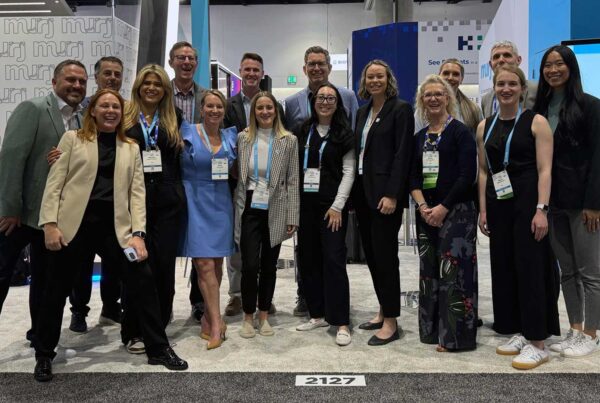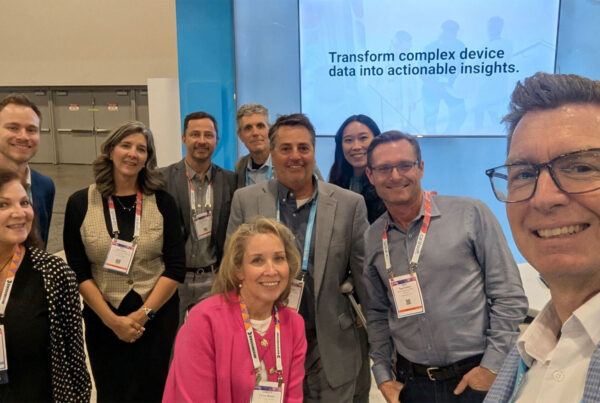


Murj® was proud to be part of the 2026 HIMSS Global Health Conference & Exhibition, where healthcare leaders, innovators, and technology partners came together to explore the future of digital health. Drawing 24,000 attendees to Las Vegas, this year’s event reflected an industry that is evolving quickly—not just in ambition, but in execution.
Across conversations, sessions, and the show floor, one thing was clear: healthcare is moving beyond the question of what’s possible and focusing on what actually works. The emphasis has shifted toward delivering real outcomes—operationally, clinically, and financially.
Murj Director of Integrations Leah Savage was on hand for the conference. Read on for her breakdown of some of the key takeaways from HIMSS 2026—covering interoperability, data enrichment, patient empowerment, and ecosystem collaboration—and what these trends mean for today’s healthcare systems striving to turn fragmented data into better outcomes.
From integration to impact: A new phase of interoperability
Interoperability remained a central theme at HIMSS, but the conversation has matured.
“The goal post for interoperability has shifted,” says Savage. “In the past, conversations were more geared around, ‘How do we get systems connected with more ease?’—the goal being to reduce the barriers to ‘get integrated’ and get data moving. Now, ‘get integrated’ is the baseline—it’s what everyone expects.”
Healthcare organizations are increasingly challenged not by a lack of data, but by the difficulty of turning that data into something usable. The next phase of interoperability is centered on:
- Improving data quality
- Standardizing and enriching datasets
- Enabling faster, more meaningful insights
In other words, the value of interoperability is no longer defined by access alone—it’s defined by utility. This evolution aligns closely with Murj’s approach: interoperability is not just about aggregating information, but about transforming fragmented data into a cohesive, actionable foundation for better decision-making.
Making data usable: The rise of data enrichment
Healthcare leaders at HIMSS 2026 emphasized that raw data accessibility alone isn’t enough—its value comes from being clean, consistent, and actionable. Simply exchanging data between systems is no longer sufficient; the focus is now on refining and enriching it so it can reliably support analytics, workflows, and clinical decisions.
“The focus has shifted to getting clean, usable data and identifying ways to enrich that data to contribute to more meaningful analytics and outcomes,” says Savage. “Data enrichment is a big focus with Murj and our interoperability efforts, so it was exciting to be surrounded by others in the space that are focused on this effort as well.”
In an interview with Healthcare IT News at the conference, Christy Bricker, Vice President of Strategic Operations at Murj, emphasized that interoperability without data readiness is insufficient. She noted that while most health systems can now move data between platforms, much of that data remains inconsistent, duplicative, or incomplete—limiting its value and, in some cases, introducing risk. Ensuring data is clean, validated, and usable is essential to turning connectivity into real clinical and operational impact.
A session from Redox also reinforced this shift, highlighting how raw interoperability data is often inconsistent and difficult to use as-is. The discussion centered on filtering, normalizing, and enriching data in-flight to make it decision-ready. This means turning interoperability data into high-quality outputs that support analytics, operations, and clinical workflows.
This underscores a shared industry priority: data is only valuable when it is both accessible and actionable, aligning closely with Murj’s approach to enriched, connected healthcare information.
Strengthening interoperability and patient-centered data
Murj participated in the pre-conference HIMSS Interoperability & HIE Forum, which brought together industry leaders to explore how to create more connected, patient-centered care through open standards. Discussions focused on overcoming persistent barriers to data exchange and moving beyond technical connectivity to measure real-world impact—improving outcomes, reducing administrative burden, and enabling more seamless experiences across the care journey.
“I was excited to see the push towards getting health records into the hands of patients more easily, allowing for easier data sharing and reduced administrative burden as patients move through care providers,” says Savage.
Murj was proud to sponsor and participate in these discussions, which emphasized the real-world impact of patient-centered interoperability and the organizations working to reshape the healthcare experience.
A commitment to continuity in a fragmented landscape
If there was one theme that resonated from HIMSS 2026, it’s this: innovation alone is not enough. The industry’s biggest challenge is not generating more data or introducing new technologies—it’s connecting and operationalizing what already exists.
Healthcare remains a highly fragmented ecosystem, where data is often siloed, workflows are disconnected, and insights are difficult to act on. The next phase of digital transformation will be defined by the ability to bring continuity to that fragmentation.
Murj is committed to helping health systems do exactly that—transforming disconnected data into a unified, usable resource that supports better decisions, stronger workflows, and improved patient outcomes. As the industry continues to evolve, we’re excited to partner with organizations that are focused not just on connecting systems, but on making those connections truly meaningful.
Want to learn more about Murj? Connect with us today.
- Stivland TM, Johnson E, Allen MA, et al. Optimizing Patient Data Migration From a Legacy On-premise CIED Database to a Cloud-based Patient Management Platform. White paper. Murj; 2025.
- Mai W, Schwartz L, Kneeland C, et al. Impact of CIED Field Advisories: Unreimbursed Costs to Medical Systems. Circ Arrhythm Electrophysiol. 2023;16(6):e011764. doi:10.1161/CIRCEP.122.011764.
- Stivland et al., “Optimizing Patient Data Migration.”